What Happens When Every Department Makes Its Own Technology Decisions?
Technology decisions are no longer made exclusively by the IT department. Finance may select a new financial platform, Human Resources may introduce an employee system, Operations may adopt specialized software, Marketing may implement new digital tools, and individual teams may begin experimenting with automation or artificial intelligence.
In many cases, this decentralization is positive. Departments understand their own challenges and are often the first to recognize where technology could improve productivity, service delivery, collaboration, or the employee experience.
The challenge begins when these individual decisions are made without considering how they fit into the organization’s broader technology environment and long-term strategy. A solution that works extremely well for one department may create duplicate information, disconnected workflows, unnecessary costs, integration challenges, or missed opportunities elsewhere.
The answer is not to centralize every technology decision. Instead, organizations need a continuous decision-making process that allows good ideas to move from departmental need to organization-wide value.
The goal isn’t to centralize every technology decision. It’s to make sure individual decisions contribute to a connected organization.
Why Are Technology Decisions Becoming More Decentralized?
Business technology has become significantly easier to adopt.
A department no longer needs to launch a major IT project every time it wants a new capability. Cloud applications can be introduced quickly, software subscriptions can be purchased online, automation can sometimes be created internally, and employees can begin experimenting with AI tools almost immediately.
That accessibility creates opportunity.
Finance may recognize a better way to produce reports. HR may want to simplify employee onboarding. Operations may identify a repetitive process that could be automated. A municipality may find a better way to deliver a service to residents. A First Nations organization may identify technology that improves program or community service delivery.
Those ideas shouldn’t automatically be discouraged because they originated outside IT.
The objective should be to give departments room to identify opportunities while creating enough strategic oversight to understand how those decisions affect the organization as a whole.
Department-level innovation becomes more valuable when it connects to organization-wide strategy.
A Good Department Decision Isn’t Always a Good Organizational Decision
Imagine one department finds an application that solves exactly the problem it has.
The platform is affordable. Employees like it. It improves a process that has been frustrating for years.
From the department’s perspective, it may be an excellent technology decision.
But the organization needs to consider a broader set of questions. Does another department already use something similar? Does the organization already own technology capable of solving the problem? Can the new application integrate with existing systems? Where will its data be stored? How will employees access it? Who will administer it? What happens to cost as adoption grows?
Most importantly, leadership should ask:
How does this decision fit into what the organization is trying to accomplish?
That doesn’t make the original idea wrong. It simply changes the conversation from “Does this solve our problem?” to “How can solving this problem create the greatest value for the organization?”
That is the difference between purchasing technology and strategically managing technology.
The Continuous Technology Decision Framework
Technology decisions shouldn’t be viewed as a straight line that ends once
something has been implemented.
They should operate as a continuous cycle.
Need → Evaluate → Align → Integrate → Measure → Improve → Need
Each stage answers a different leadership question.
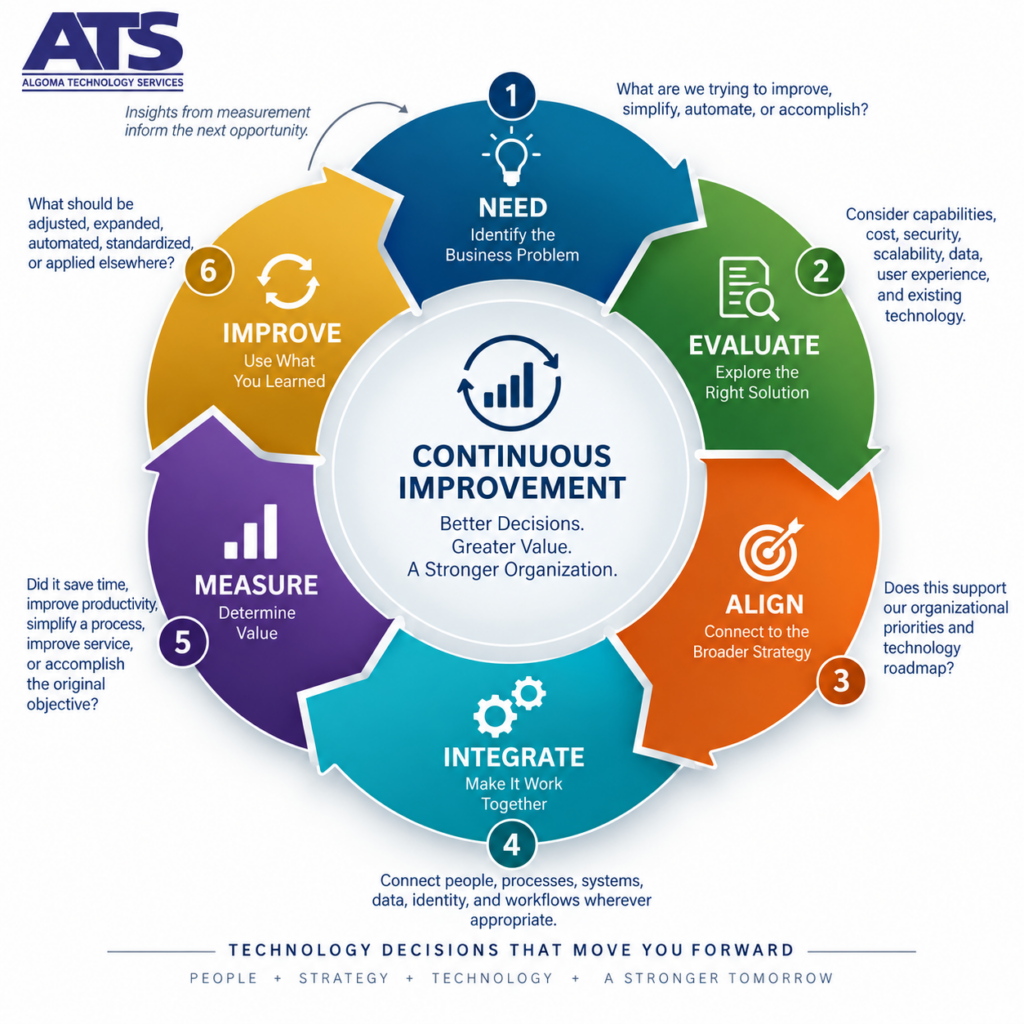
1. Need: What Business Problem Are We Trying to Solve?
Every technology decision should begin with the business outcome—not the product.
An organization may want to save employee time, automate repetitive work, improve collaboration, make information easier to access, improve service delivery, or create a capability that doesn’t exist today.
Starting with the need keeps leadership from prematurely defining the solution.
Instead of saying, “We need this application,” the conversation becomes, “We need a better way to accomplish this outcome.”
That creates more options.
The organization may discover that it already owns technology capable of solving the problem. Two existing systems may need to be connected. A workflow could potentially be automated. Employees may need better training. Or the process itself may simply need to be redesigned.
Start with the business need. Then determine the technology.
2. Evaluate: What Is the Right Solution?
Once the need is clearly understood, the organization can evaluate how best to address it.
Features are important, but they shouldn’t be the only consideration. A technology decision also needs to make sense within the environment where it will operate.
Depending on the significance of the investment, leadership may consider:
- Capability and user experience
- Cost and future licensing
- Cybersecurity and data handling
- Integration with existing systems
- Scalability
- Vendor support
- Administration and ownership
- Capabilities the organization already owns
Not every application needs a lengthy procurement exercise. The evaluation process should be proportional to the importance and potential impact of the decision.
The objective is simply to answer two questions:
Does it solve the problem?
And:
Does it fit the organization?
Both matter.
3. Align: Does It Support the Broader Strategy?
This is where a technology roadmap becomes particularly valuable.
A department may identify an opportunity independently, but that opportunity could connect directly to something leadership has already identified as an organizational priority.
For example, Operations may discover an automation opportunity while leadership has employee productivity on the technology roadmap. HR may identify a new digital process that supports a broader employee-experience initiative. One department may discover an AI use case that could eventually benefit several others.
Strategic alignment allows leadership to recognize those connections.
It also helps determine priority. Organizations rarely have unlimited time, budget, or internal resources, so even good ideas have to be considered against other initiatives.
“Some of the best organization-wide technology improvements begin with one department solving one problem well.”
The question becomes not only whether the idea is good, but whether it supports where the organization is going.
4. Integrate: How Will It Work With Everything Else?
Technology can perform perfectly on its own and still create a poor employee experience.
Consider an employee who retrieves information from one system, manually enters it into a spreadsheet, emails that spreadsheet for approval, receives it back, and then enters the same information into another application.
Every system may technically be working.
The workflow isn’t.
Integration is about looking beyond individual applications and considering how people, processes, systems, data, identity, and workflows work together.
This is increasingly important as organizations operate across Microsoft 365, cloud applications, line-of-business platforms, AI, automation, cybersecurity systems, and specialized departmental technology.
The objective isn’t to integrate everything simply because it can be integrated. It is to identify where integration can remove unnecessary work, improve access to information, reduce duplication, or create a better experience.
The value of technology isn’t only found in individual systems. It’s also found in how effectively those systems work together.
5. Measure: Did Something Actually Improve?
Implementation shouldn’t be the finish line.
Return to the original business need and ask whether the technology produced the intended outcome.
If the objective was productivity, did employees save time? If it was collaboration, did the process become easier? If it was automation, how much repetitive work disappeared? If the objective was service delivery, did customers, residents, employees, or community members experience an improvement?
Even small improvements can become significant at scale.
For example, imagine a new workflow eliminates 15 minutes of repetitive work per day for 20 employees. Across approximately 260 working days, that represents about 1,300 employee hours per year.
That gives leadership something more meaningful to evaluate than whether the application was successfully installed.
The organization can begin measuring technology against business outcomes.
Technology success shouldn’t simply mean that something was implemented. It should mean that something improved.
6. Improve: What Did We Learn?
This is the stage that makes the framework circular.
Measurement isn’t just about proving whether an investment worked. It should help determine what happens next.
Perhaps the technology worked well, but employees need additional training. Maybe the process can now be automated further. A successful departmental implementation might make sense elsewhere in the organization. Or the results may show that the original approach needs to be adjusted.
Those insights create the next opportunity.
Measure → Improve → Need
The cycle starts again.
This prevents technology strategy from becoming a collection of projects that are completed and forgotten. Instead, the organization develops an environment that continually learns and evolves.
Technology strategy shouldn’t end at implementation. Measure the outcome, learn from it, and use those insights to drive the next improvement.
Why Does the Circular Technology Model Matter?
Traditional technology projects can easily become linear: identify a requirement, select technology, implement it, and move on.
But the organization doesn’t stop changing when the project ends.
Employees discover new ways of working. Business priorities evolve. New AI capabilities emerge. Cybersecurity expectations change. Vendors introduce new functionality. Organizations grow, restructure, or introduce new services.
The technology environment has to evolve with those changes.
A continuous decision framework creates that feedback loop.
Need → Evaluate → Align → Integrate → Measure → Improve → Need
Instead of leadership asking, “Is the technology project finished?”, the better question becomes: “What did we learn, and what should we improve next?”
That is a fundamentally different approach to technology planning.
How Does AI Change Department-Level Technology Decisions?
AI makes this conversation even more important because experimentation can happen faster than traditional technology planning cycles.
Employees can discover AI capabilities for research, document creation, analysis, automation, reporting, communication, and knowledge retrieval without waiting for a formal technology project.
That experimentation can be extremely valuable.
The challenge for leadership is determining which experiments should remain individual productivity tools and which have the potential to become organizational capabilities.
The same framework can help.
An organization can identify the Need, Evaluate whether AI is an appropriate solution, Align the use case with organizational priorities, Integrate it responsibly where necessary, Measure the outcome, and then Improve or expand the approach based on what was learned.
This creates a path from experimentation to responsible innovation without assuming that every new AI capability needs to become an organization-wide initiative.
Who Connects All of These Technology Decisions?
A continuous technology decision process requires several perspectives.
Department leaders understand operational challenges. Employees understand where everyday friction occurs. Internal IT understands the technology environment. Finance understands budgets. Cybersecurity professionals understand security requirements. Executive leadership understands where the organization needs to go.
The challenge is connecting those perspectives.
At ATS, Technology Alignment Management helps establish where a client’s technology environment stands today and identifies areas where greater alignment or improvement may be needed.
The vCIO can then work with leadership to connect those findings to organizational priorities, future initiatives, budgets, and the technology roadmap.
There is an important distinction between the two:
Technology Alignment helps establish where the environment stands today. The vCIO helps determine where it needs to go next.
Once improvements are implemented, the process doesn’t stop. Results can be reviewed, priorities can change, and new needs can be incorporated into the roadmap.
That is where technology planning becomes a continuous management discipline rather than a collection of disconnected projects.
Better Technology Decisions Can Create a More Connected Organization
The purpose of this framework isn’t to slow departments down.
It’s to help good ideas go further.
A department may identify the initial need. IT may help evaluate the solution. Leadership may connect the opportunity to broader priorities. Technology teams may integrate it into the environment. Employees may demonstrate whether it actually works. Measurement may then reveal the next opportunity.
Everyone contributes to the cycle.
The result is a healthier relationship between departments, IT, and executive leadership. Technology becomes something the organization continuously improves together rather than something individual departments purchase independently.
And importantly, departments can remain a source of innovation.
They simply have a clearer path for turning a good departmental idea into greater organizational value.
Final Perspective
Every department making technology decisions isn’t necessarily a problem. It can be a sign that people across the organization are actively looking for better ways to work.
The opportunity is to combine that initiative with enough strategic technology leadership to ensure those decisions work together.
Start with the business need. Evaluate the right solution. Align it with organizational priorities. Integrate it where doing so creates value. Measure whether the expected outcome occurred. Then use what you learned to identify the next improvement.
And repeat.
Because the strongest technology strategies aren’t static.
They learn, adapt, and continuously improve.
Book Your Strategy Call Today.