
Why Employees Should Be Part of Your Cybersecurity Strategy—Not Just Your Biggest Risk
For years, employees have often been described as the “weakest link” in cybersecurity. But that description overlooks the important role people can play in protecting an organization.
Employees are often the first people to encounter suspicious emails, unusual payment requests, unexpected password resets, questionable links, unfamiliar login prompts, and communications that appear to come from executives, vendors, or colleagues. As social engineering becomes more convincing, some of those interactions will inevitably make it through technical security controls.
Technology can block a great deal. It cannot guarantee that every malicious message or convincing request will be stopped before someone sees it.
That makes employee preparedness an essential part of a modern cybersecurity strategy. Employees need to know how to recognize something unusual, verify sensitive requests, report concerns quickly, and respond appropriately if they make a mistake.
A practical approach is to treat employee cybersecurity as a continuous process:
Educate → Simulate → Verify → Report → Improve
You can’t eliminate every bad click. You can build an organization that is prepared for what happens next.
Employees Aren’t Simply a Cybersecurity Risk
Cybersecurity conversations have traditionally focused heavily on preventing employees from making mistakes.
Don’t click the link. Don’t open the attachment. Don’t share the password. Don’t approve the unexpected login request.
Those instructions remain important, but they represent only part of the employee’s role in cybersecurity.
An employee can also be the first person to recognize that something is wrong.
Someone in Finance might notice that a supplier’s banking information has unexpectedly changed. An executive assistant may recognize that an urgent request doesn’t match how an executive normally communicates. An employee may receive an authentication request when they aren’t trying to sign in. Someone may notice that an email from a familiar contact simply doesn’t fit the context of the conversation.
Those moments matter.
A prepared employee who stops, verifies, and reports something unusual can interrupt an attack before it progresses further.
That changes the role employees play in cybersecurity.
They aren’t simply people the organization needs to protect from making mistakes. They can also become an important layer of awareness and detection.
An employee who spots a threat can be the reason it stops.
The Continuous Employee Cybersecurity Framework
Annual cybersecurity training can provide a useful foundation, but employee preparedness shouldn’t be treated as a once-a-year exercise.
Threats change. Technology changes. Employees change roles. New employees join the organization. Attackers change how they communicate and who they target.
Employee cybersecurity should evolve as well.
A continuous framework provides a simple way to approach it:
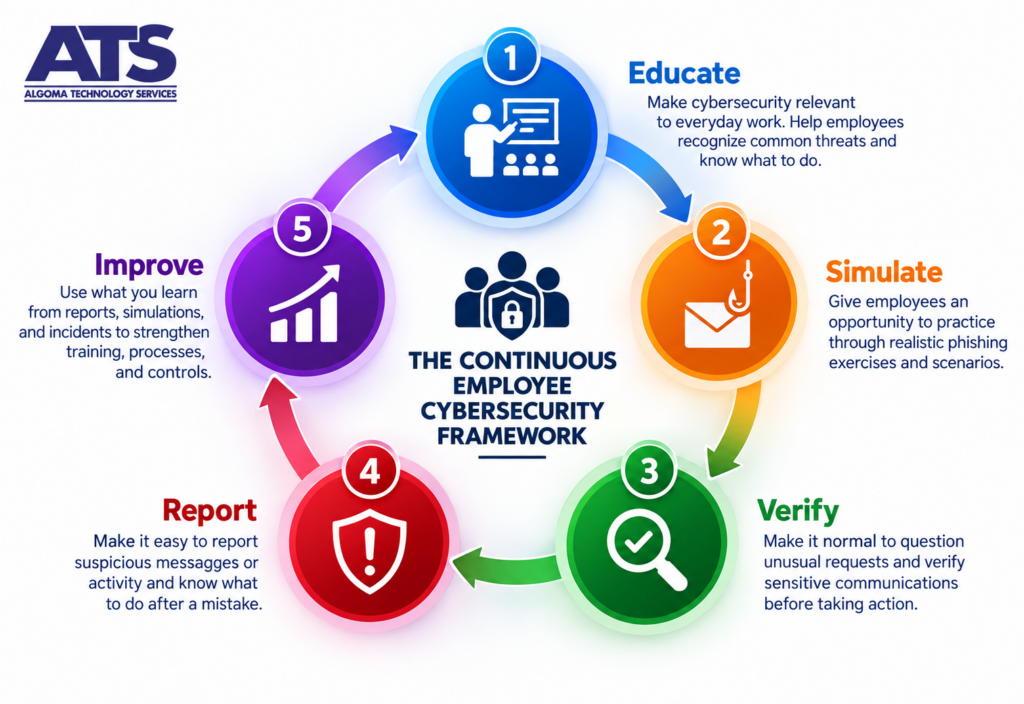
Each part of the cycle reinforces the next. The objective isn’t to turn employees into cybersecurity professionals. It’s to give them enough knowledge, practice, and confidence to make better decisions when something unusual happens.
1. Educate: Make Cybersecurity Relevant to Everyday Work
Cybersecurity education is most useful when employees can connect it directly to situations they may actually encounter.
The risks facing someone in Finance may look different from those facing HR, senior leadership, Operations, or an employee who regularly communicates with vendors and customers.
A Finance employee may encounter a fraudulent payment request. HR may receive messages designed to obtain employee information. Executives may be targeted with highly personalized impersonation attempts. Employees throughout the organization may encounter fake Microsoft 365 notifications, password reset requests, shared documents, QR codes, or unexpected authentication prompts.
Training should help employees recognize the patterns behind these situations without expecting them to become technical experts.
Employees should understand when urgency is unusual, when a request for credentials doesn’t make sense, when changes to payment information require additional verification, and when an unexpected authentication request deserves immediate attention.
The real measure of education isn’t whether someone remembers every point from a training session.
It’s whether that knowledge influences what they do when a real situation appears.
Cybersecurity awareness becomes valuable when employees can apply it to decisions they make every day.
2. Simulate: Give Employees an Opportunity to Practice
Recognizing a suspicious message during a training session is very different from recognizing one in the middle of a busy workday.
That’s why simulation can be valuable.
Realistic phishing exercises give employees an opportunity to practice identifying suspicious behaviour in a controlled environment. They can also help an organization understand where additional education or stronger processes may be required.
But simulation should be used carefully.
The objective shouldn’t be to trick employees so the organization can produce a failure percentage. A useful simulation should generate information that helps both employees and the organization improve.
For example, repeated simulations may reveal that employees have difficulty identifying a particular type of impersonation attempt. They may show that people recognize suspicious emails but aren’t sure how to report them. Or they may identify a department where additional role-specific education would be valuable.
Simulation becomes much more useful when it creates learning rather than embarrassment.
The purpose isn’t to catch people making mistakes. It’s to help people make better decisions when the situation is real.
3. Verify: Make It Normal to Question Unusual Requests
Some of the most effective cybersecurity habits are also among the simplest.
When something important feels unusual, verify it.
This is especially relevant when a request involves money, credentials, sensitive information, account access, or a change to an established business process.
If a familiar supplier suddenly requests that payments be sent to a different account, the organization should have a process for independently confirming that change. If an executive appears to make an unusual financial request, employees should feel comfortable verifying it through another trusted communication method. If someone receives an unexpected authentication prompt, approving it simply to make the notification disappear should never be considered normal behaviour.
Verification doesn’t need to make everyday work unnecessarily difficult. It needs to be built into the moments where the potential impact justifies an additional check.
That also requires support from leadership.
Employees should never feel that questioning an unusual request from a manager, executive, vendor, or colleague is inconvenient or inappropriate.
Trust the relationship. Verify the request.
4. Report: Make Speaking Up Easy
Employees need a clear answer to one of the most important cybersecurity questions:
What do I do if something looks suspicious?
The reporting process should be easy to remember and easy to use. Depending on the organization, that may include a phishing-reporting feature within email, contacting the help desk, notifying internal IT, or following another clearly established process.
Just as importantly, employees need to know what to do after they think they may have made a mistake.
Someone may click a link and then realize the page looked unusual. They may enter credentials before recognizing something was wrong. They may approve an authentication request they weren’t expecting. They may open an attachment or share information and become concerned afterward.
At that point, speed matters.
An employee who reports the situation immediately gives IT or the cybersecurity team an opportunity to investigate and respond sooner.
That is why the culture surrounding reporting is so important.
If employees believe admitting a mistake will primarily result in blame or embarrassment, they may hesitate. If they understand that rapid reporting helps protect the organization, they are much more likely to speak up. A fast report can be as important as avoiding the original mistake.
5. Improve: Learn From What Employees Are Seeing
Every simulation, suspicious message, employee report, and real incident can teach the organization something.
Perhaps a certain type of message is becoming more difficult for employees to recognize. Maybe a business process makes impersonation easier than it should be. An employee may correctly identify a suspicious request but discover there isn’t a clear verification procedure. A reported incident may reveal an opportunity to strengthen a technical control.
Those insights should influence what happens next.
Sometimes the answer will be additional education. Other times it may involve adjusting a process, improving identity protection, changing how financial requests are verified, strengthening email security, or making reporting easier.
This is why Improve returns to Educate.
The organization learns from what employees encounter and uses those lessons to strengthen the next round of preparation.
That is much more valuable than treating cybersecurity awareness as an annual checkbox.
What Happens After the Click Matters Too
Organizations should absolutely work to prevent employees from interacting with malicious content.
But a mature cybersecurity strategy also assumes that prevention will never be perfect.
Eventually, someone may click something they shouldn’t.
What happens next can determine whether that moment remains a small incident or becomes a much larger problem.
Employee awareness is one layer of defence. Email security, identity protection, multi-factor authentication, endpoint security, monitoring, access controls, backups, and incident response processes provide additional layers.
When those layers work together, the organization’s cybersecurity strategy doesn’t depend on one person making the perfect decision every time.
Neither employees nor technology should be expected to carry the organization’s cybersecurity strategy alone. Resilience comes from people, processes, and technology reinforcing one another, so that when one layer misses something, another has an opportunity to detect and contain it.
Resilience comes from people, processes, and technology working together.
AI Is Changing What Employees Need to Recognize
Artificial intelligence is making the human side of cybersecurity more important.
Employees have traditionally been told to watch for obvious warning signs such as poor grammar, strange formatting, or messages that don’t sound professional. Those clues can still be useful, but they shouldn’t be relied upon.
AI can make fraudulent communication more polished and convincing. A suspicious message may be well written, appropriately formatted, and appear consistent with normal business communication.
That shifts more attention toward context and behaviour.
Does the request make sense?
Is the level of urgency unusual?
Is someone asking an employee to bypass a normal process?
Does the communication involve credentials, money, confidential information, or account access?
Can the request be verified independently?
Employees don’t need to determine whether AI created a message. They need habits that continue to work even when the message itself looks convincing.
As fraudulent communication becomes more convincing, verification becomes more important than appearance.
This also connects cybersecurity awareness to a larger organizational challenge: trust.
The more difficult it becomes to determine whether digital communication is genuine based on appearance alone, the more important clear processes and verification become.
Cybersecurity Culture Starts With Leadership
Employees take their cues from leadership.
If executives routinely bypass security processes because they are inconvenient, employees notice. If managers discourage people from questioning unusual requests, employees notice. If someone reports a mistake and the first response is blame, employees remember that too.
Leadership can create a very different environment.
Executives can follow the same verification procedures expected of employees. Managers can reinforce that asking questions is appropriate when something seems unusual. Employees can be encouraged to report concerns immediately rather than spending valuable time deciding whether something is serious enough to mention.
This is especially important because executives themselves can be used as part of an attack.
An employee who receives an unusual message that appears to come from senior leadership needs to know that verifying the request is expected—not disrespectful.
A simple leadership message can establish that expectation:
“If a request from me seems unusual, verify it. I would rather you ask than assume.”
Cybersecurity culture becomes stronger when secure behaviour is demonstrated from the top of the organization, not simply required by IT.
Building Cybersecurity Preparedness Around People and Technology
Effective cybersecurity requires more than adding security products.
Technology plays a critical role, but the environment also depends on people knowing what to do, processes supporting good decisions, and leadership reinforcing the right behaviours.
At ATS, our approach to managed and co-managed IT recognizes that these elements need to work together. Technical security controls can help prevent and detect threats, while employee awareness and clear processes can strengthen how the organization responds when something unusual reaches a person.
For organizations with internal IT teams, this can also be a collaborative effort. Internal IT understands the organization’s people and processes, while an external technology partner can provide additional cybersecurity depth, monitoring, testing, strategic guidance, and specialized capabilities.
The objective isn’t to build a cybersecurity strategy around the assumption that nobody will ever make a mistake.
It is to create enough layers that one mistake does not automatically become a major incident.
Final Perspective
Cybersecurity threats will continue to become more convincing, and even well-prepared employees will occasionally encounter situations where the right answer isn’t immediately obvious.
That is why employee cybersecurity should be treated as a continuous process rather than an annual training requirement. Education builds awareness. Simulation provides practice. Verification creates better habits. Reporting helps the organization respond sooner. Improvement ensures that what the organization learns becomes part of its next defence.
Employees don’t need to become cybersecurity experts. They need the confidence to recognize when something feels wrong, the process to verify it, and a clear way to report it.
When those behaviours are supported by strong technology, clear processes, and leadership, employees become part of the organization’s defence—not simply another risk to manage.
You can’t prevent every click. You can prepare your people for what comes next.
Book Your Strategy Call Today.